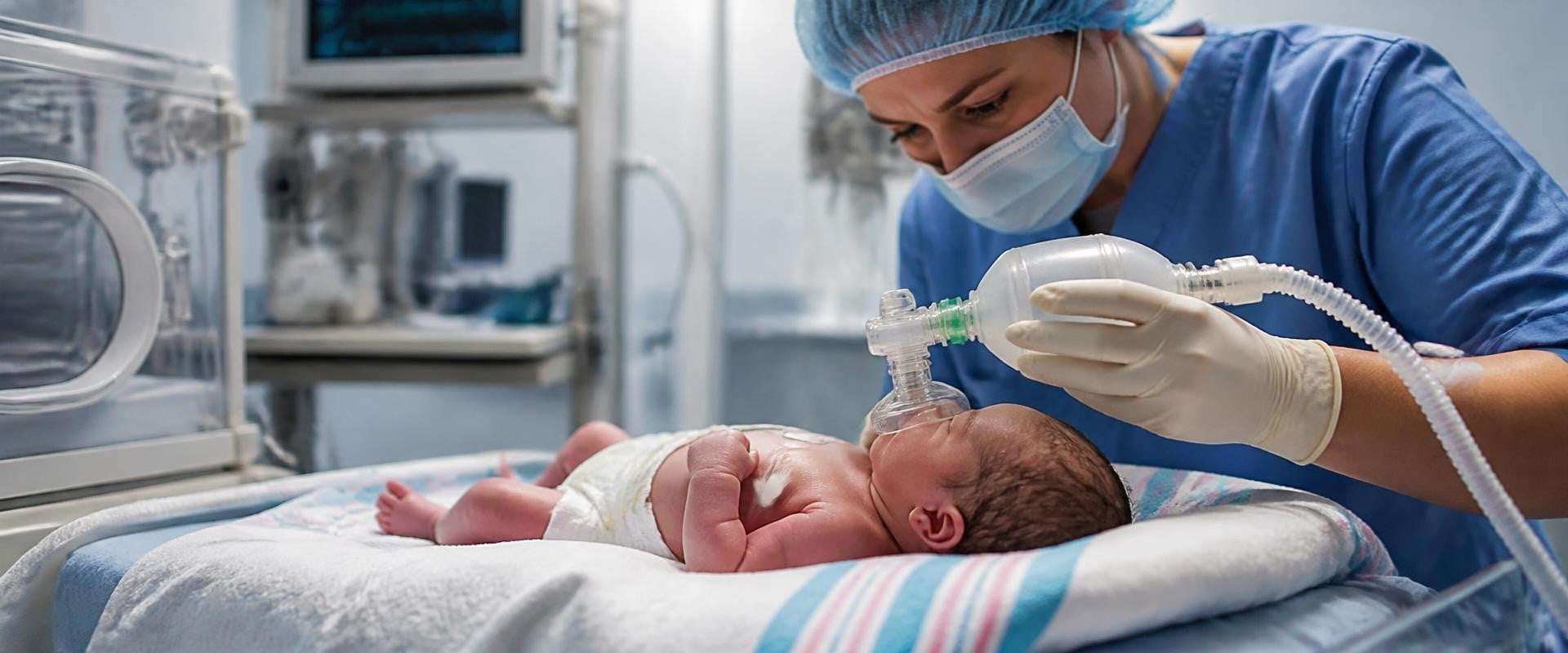
Birth asphyxia requires immediate medical attention when a newborn cannot establish adequate breathing and circulation. Treatment begins with newborn resuscitation and may continue in a neonatal intensive care unit. Babies with significant neurological dysfunction may require additional treatment to reduce the risk of long-term brain injury.
Why immediate newborn treatment matters
The transition from fetal circulation to independent breathing occurs shortly after birth.
During pregnancy, the placenta provides oxygen.
After delivery, the baby's lungs must take over that function.
Most newborns begin breathing without extensive assistance.
However, some experience difficulty establishing effective respiration.
When breathing is absent or inadequate, oxygen delivery to vital organs can become compromised.
Prompt resuscitation helps establish ventilation and restore adequate circulation.
The immediate goal is to stabilize the baby while identifying possible underlying causes.
The first steps in newborn resuscitation
Medical teams begin by assessing breathing, heart rate, and other clinical findings.
Initial care may include warming, drying, positioning the airway, and providing appropriate stimulation.
If the baby remains apneic, gasps, or has a heart rate below the recommended threshold, positive-pressure ventilation is indicated.
Effective ventilation is the most important intervention for many newborns requiring resuscitation.
Healthcare professionals monitor the baby's heart rate to assess whether treatment is working.
When ventilation does not produce an adequate response, clinicians evaluate airway positioning, mask seal, and other possible problems.
Some newborns require advanced airway support.
These interventions must be performed by trained medical professionals.
When chest compressions and medications are needed
Most newborns who require resuscitation respond to effective ventilation.
A smaller number need additional interventions.
If the heart rate remains below the recommended threshold despite adequate ventilation, chest compressions may be necessary.
Medication may be required when the baby's condition does not improve after appropriate ventilation and compressions.
These decisions follow established neonatal resuscitation protocols.
The sequence matters because inadequate ventilation is a common reason newborn heart rates remain low.
Medical teams must continually reassess the baby's response.
Monitoring after successful resuscitation
A baby who initially improves may still require close medical observation.
Significant birth asphyxia can affect the brain, kidneys, heart, and other organs.
Doctors may monitor blood gases, glucose, electrolyte levels, and organ function.
Neurological examinations help identify signs of encephalopathy.
Some infants undergo electroencephalographic monitoring to detect seizures.
Feeding and breathing support may also be necessary.
The duration of monitoring depends on the severity of the initial event and the baby's recovery.
Therapeutic cooling for eligible newborns
Some infants develop moderate or severe hypoxic-ischemic encephalopathy following significant oxygen deprivation.
Eligible newborns may receive therapeutic hypothermia.
This treatment lowers body temperature in a controlled medical setting.
The objective is to reduce secondary neurological injury.
Cooling is generally started within six hours of birth.
The treatment usually lasts approximately 72 hours before gradual rewarming.
Careful monitoring is essential throughout the process.
Although therapeutic hypothermia improves outcomes for some infants, it does not guarantee complete recovery.
Long-term medical follow-up
Newborns who experience significant birth asphyxia may need ongoing developmental assessment.
Some children show no lasting neurological problems.
Others develop motor delays, hearing difficulties, seizures, or learning challenges.
Early intervention services may help address developmental needs.
Physical therapy, occupational therapy, and speech-language services can support affected children.
Families should discuss recommended follow-up with the child's healthcare team.
Common questions around birth asphyxia treatment
What is the first treatment for a newborn who cannot breathe?
Medical professionals prioritize effective ventilation while assessing the baby's heart rate and overall condition.
Does every baby with birth asphyxia need cooling therapy?
No. Cooling is used for selected infants who meet established criteria for moderate or severe HIE.
Can resuscitation prevent permanent brain injury?
Prompt and effective resuscitation can reduce ongoing oxygen deprivation, although it cannot reverse every injury.
