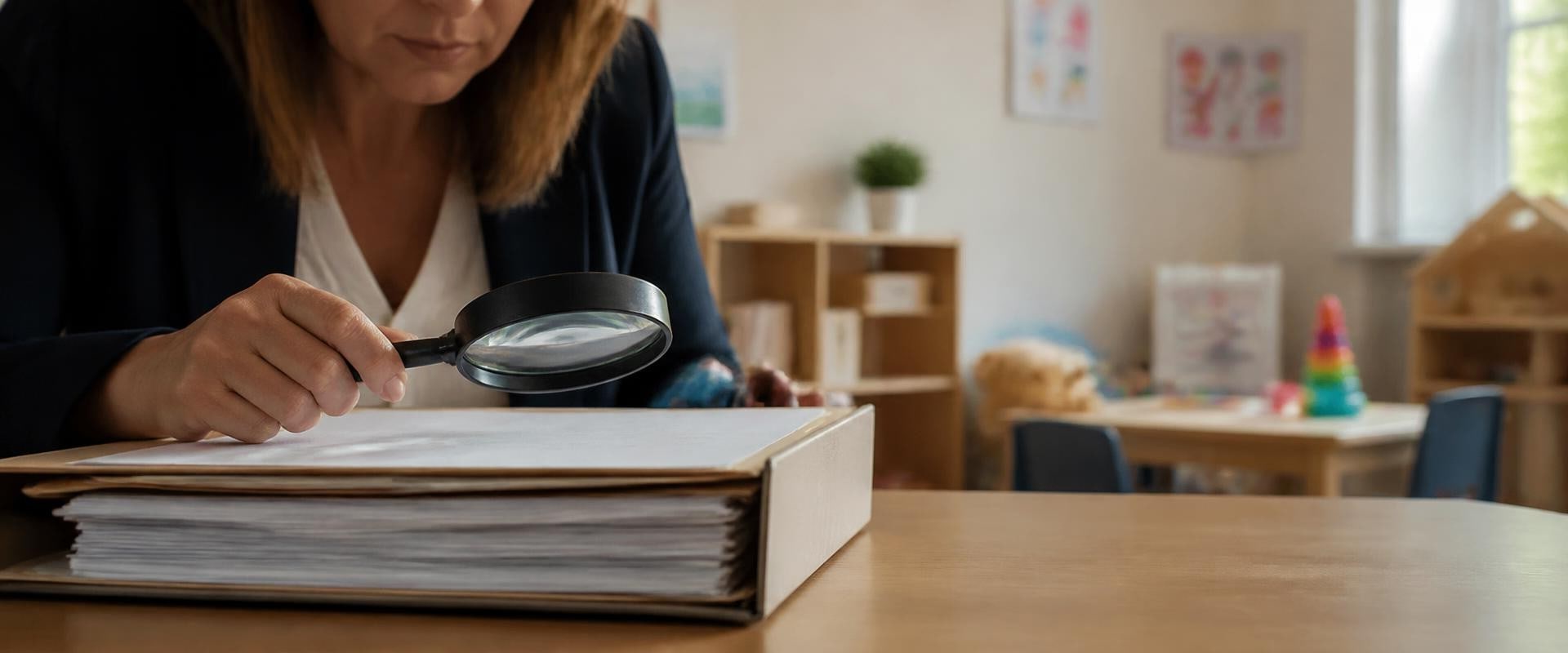
Every parent who enrolls a child in an Illinois daycare is relying, often without realizing it, on a screening system. State law requires licensed centers and homes to check the people they bring into contact with children before those people are trusted on their own. When a child is sexually abused by a staff member or volunteer, one of the first things worth asking is whether that system was actually followed.
Seeking answers through a civil claim does not depend on a police report or a criminal conviction. The claim focuses on the center and its license holder: what they knew, what they should have known and how they acted.
The Screening Requirement
Section 4.1 of the Child Care Act of 1969, 225 ILCS 10, requires every employee and volunteer of a licensed center or home to authorize a criminal background investigation as a condition of employment. Fingerprints are checked against Illinois State Police and FBI records. The Illinois Department of Early Childhood (IDEC), which took over as lead licensing agency on July 1, 2026, describes the complete process as state, FBI and out-of-state criminal checks plus searches of the Child Abuse and Neglect Tracking System (CANTS) and the Sex Offender Registry.
Who Cannot Be Hired
Section 4.2 prohibits a licensed provider from employing anyone convicted of listed offenses. Those offenses include criminal sexual assault, predatory criminal sexual assault of a child and criminal sexual abuse.
The Probationary Period
The law allows a new hire to begin work on a probationary basis once certain fingerprint results come back. Until that person is fully cleared, however, they must be supervised at all times by someone who has cleared every part of the background check. That rule is easy to state and easy to ignore during a busy day or a staffing shortage.
Questions a Claim Will Ask
The screening rules lead to concrete lines of inquiry. Was the background check started before the person began working? Was a new hire left alone with children before receiving full clearance? Were volunteers checked as well as paid staff? In a home daycare, were adults living in the home screened? The answers usually appear in the center's personnel and clearance records.
A Clean Check Is Not the End
Passing a background check only means nothing was on file. Many people who harm children have no criminal record. That is why these cases also look closely at supervision: who was in the room, whether staff ratios were kept and whether any adult was regularly alone with children in ways the center should have prevented.
Supervision questions are often very specific. Were children ever taken to a separate room by one adult for diapering, napping or toileting? Who covered the room during breaks, early drop-off or late pickup? Did the center allow a particular staff member, relative of the owner or frequent visitor to be alone with a child as a matter of routine? Staff schedules and sign-in sheets can show who was present at a given hour, and they often reveal gaps between the center's written policies and what actually happened day to day.
Hiring as the Core Theory
Daycare claims are usually brought against the center and its license holder rather than only the individual. Negligent hiring is the theory that most often carries them, and other theories such as negligent supervision commonly run alongside it. Which combination fits depends on the facts.
Most daycares are private businesses. For them, the Illinois Tort Immunity rules that govern claims against public bodies do not apply in the same way.
Where the Records Are
Because Illinois licenses childcare facilities, there is usually a state licensing file in addition to the center's own records. Through a case, a lawyer can seek the center's background clearances, staff schedules, sign-in sheets, incident reports and the mandated reporter statements staff sign when hired. Those documents can show whether screening and supervision rules were followed in practice.
What Parents Often Ask
How would I know if the daycare skipped a background check? Clearance records are kept by the center and can be requested in a case. Licensing reports may also note violations.
The person who hurt my child had no criminal record. That is common. The case then focuses on supervision and access.
Is a criminal conviction required? No. A civil claim uses a lower standard of proof.
I'm reaching out for my niece or grandson. That is fine. Asking creates no obligation for anyone.
Working With Our Firm
A call to us is a conversation, not a commitment. You will speak with a person and can share as little as you like. If you would like us to dig in, we investigate at no cost who was responsible, what screening was done, what the center knew, which records exist and whether a claim can still be filed. We then give you an honest assessment, and the decision is yours. If you stop, nothing you said goes anywhere. If you continue, we handle filings, deadlines, records and insurers, and can request protections for your family's identity.
Get in Touch
Ervin Nevitt joined the Illinois bar in 2014 and is a partner at Coplan + Crane. The firm answers (708) 671-6858 day and night from 60 W Randolph St, Suite 333, Chicago, IL 60601.
To report suspected child abuse, call the DCFS hotline at 1-800-25-ABUSE (1-800-252-2873). RAINN offers free, private support at 1-800-656-4673, every hour. If a child faces immediate danger, call 911. To learn more, visit: https://survivorsofabuseil.com/daycare-sexual-abuse-lawyer-il/
Attorney advertising. The material above is general and does not constitute legal advice.
